What survives the export. Exactly.
A render is only worth showing a client if it depicts the kitchen they are buying — the real cabinets, the real dimensions, the real finishes. So this page is specific about what arrives when a 2020 Design Flex export lands in RenderFactor, including the parts that don’t, because a fidelity claim you can’t check is marketing.
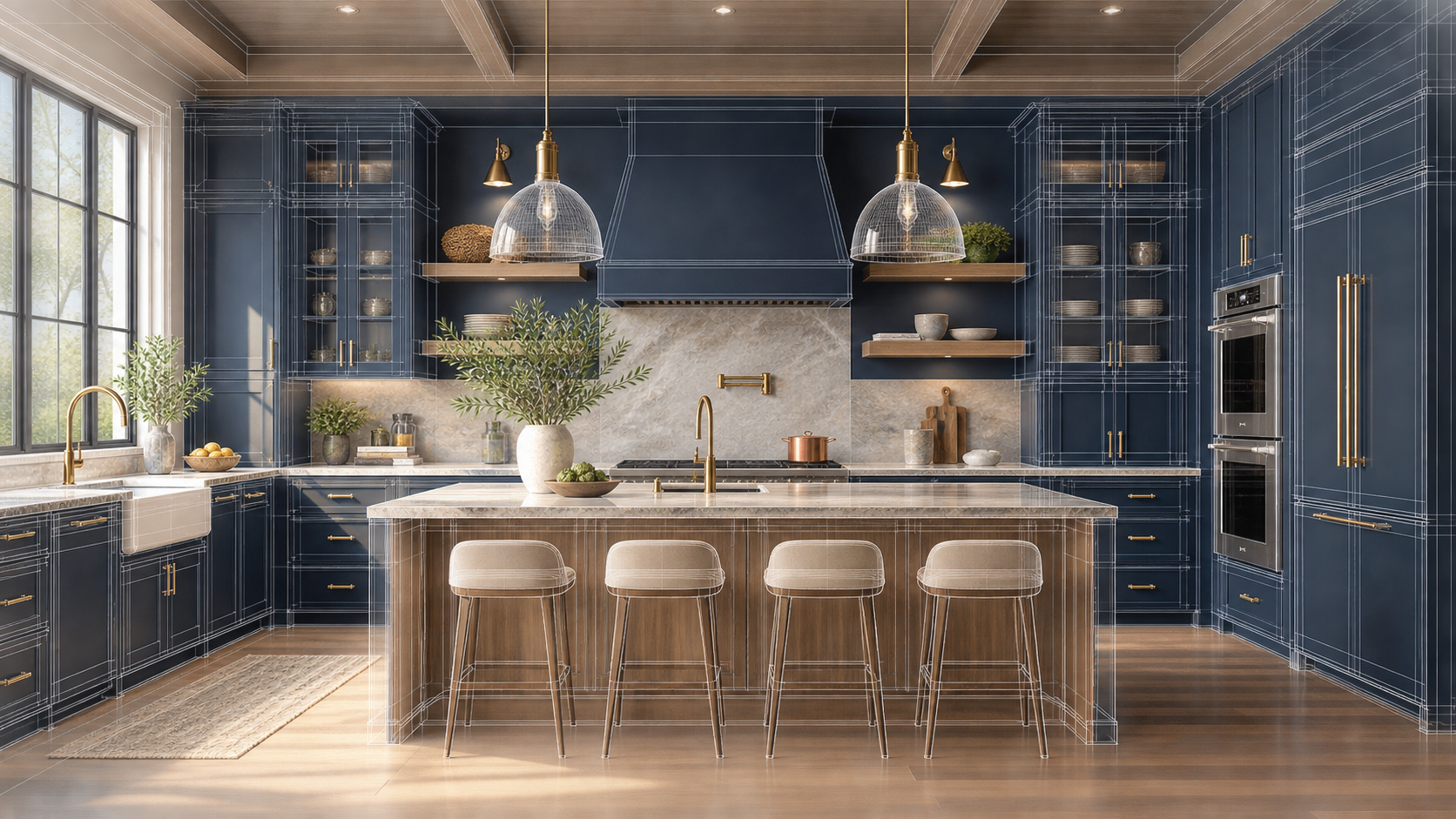
- Every mesh, as authored — no decimation, no rebuilding
- Hierarchy, placements and instancing
- 1:1 scale, read from the export itself
- Custom, curved and angled cabinets
- Moldings, fillers, panels, toe kicks
- Appliances — never swapped for lookalikes
- Every texture, byte-for-byte
- Surface response — 2020 writes flat photographs
- 2020's light data
- 2020's cameras
- Physical light fixtures, wattage and kelvin
- Cameras with real lenses, saved per shot
- Finish response layered over your textures
- Décor from a curated library
Geometry: every triangle, as authored
The importer converts the COLLADA export without touching the shapes: no decimation, no welding, no re-meshing, no smoothing — guaranteed by named tests in the conversion pipeline, not by policy. The object hierarchy and instancing survive intact, and scale is 1:1, read from the export’s own unit declaration rather than assumed; an implausible room size fails the import report rather than shipping quietly.
- Custom and curved cabinets. A mesh is a mesh: custom work, angled runs and curved fronts arrive at exactly the detail 2020 exported them with. Nothing re-tessellates a curve.
- Moldings, fillers, panels, toe kicks. All geometry in the export, all imported. Nothing is dropped by category.
- Appliances and catalog items. Rendered as the exact geometry 2020 placed. Nothing is ever swapped for a lookalike model, and nothing is guessed from a product name.
Materials: what 2020 wrote, until you say otherwise
Every texture in the export is embedded byte-for-byte — found even when Windows and the archive disagree about letter case — and colours are colour-managed correctly, so each surface shows exactly what 2020 exported until a designer changes it. Choosing a wood, stone, tile or laminate finish keeps your exported texture and layers real light response over it; paint, glass and metal replace it, because paint covers grain in real kitchens too. Everything is one click reversible — the original is still in the file.
The two things the export does not carry
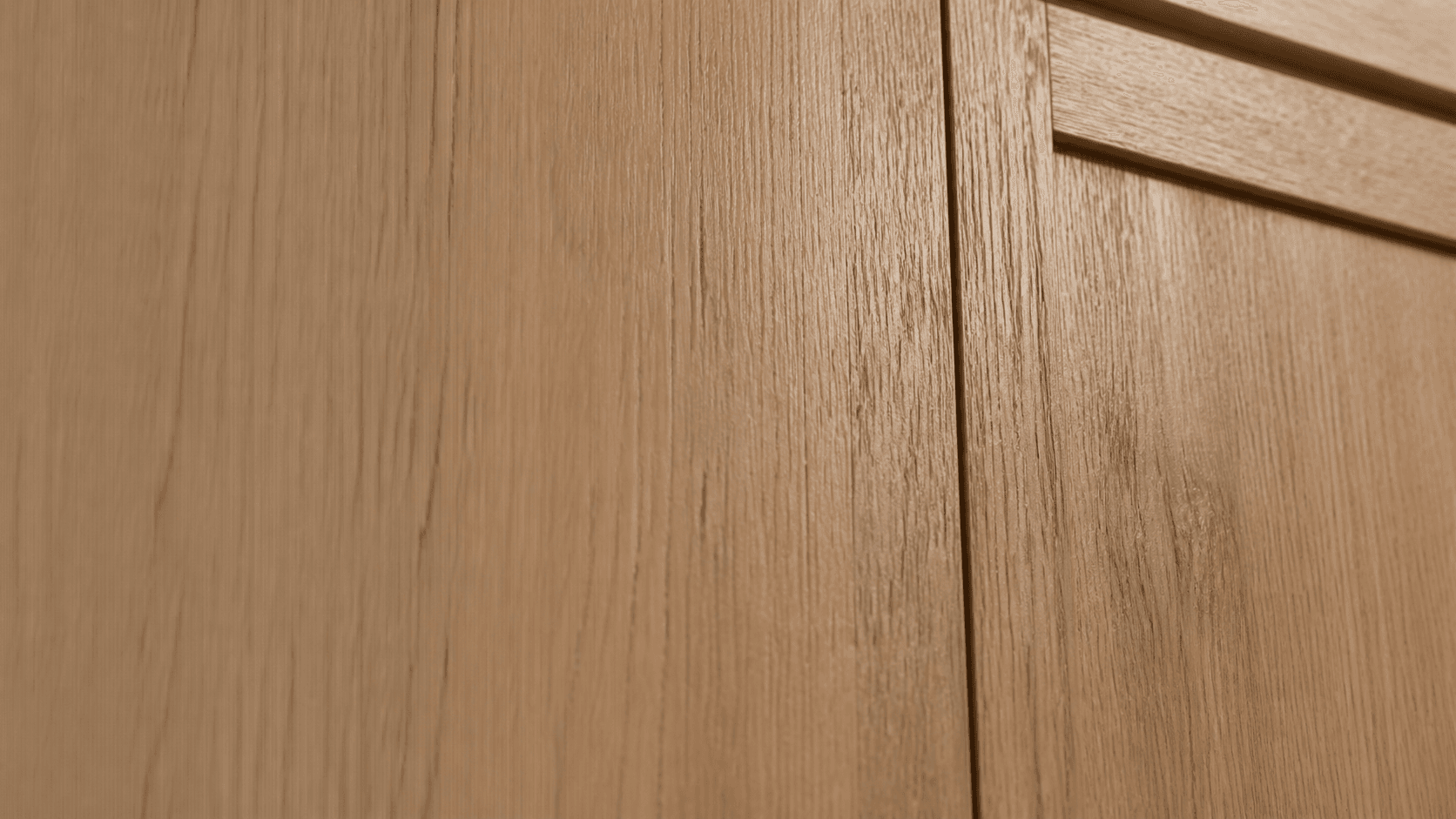
- Surface response. 2020 exports materials as flat photographs — no roughness, no relief, no metallic data. The photograph comes through unchanged, and RenderFactor adds the physical response on top, which is why the same oak reads as wood rather than as a picture of wood.
- Lights and cameras. 2020’s light data and cameras are not imported. The fixtures themselves still render — they are geometry — but the light comes from fixtures you place in RenderFactor, with physical brightness and colour temperature the export never carried. Cameras likewise are authored here, with real lenses.
Anything else unusual — a missing texture, an ambiguous file, an odd size — lands in the import report, in words, before you spend a render.
The proof is a side-by-side
None of this needs believing. Export a real kitchen (five minutes), render it on the trial, and put the result beside what your current pipeline produces from the same project — same room, same cabinets, your judgement. That is what the trial images are for.
Bring your next 2020 project.
Free for 14 days on your own kitchen: render it at every quality and hand a client a live link before you have paid anything. Cancel in one click.
Start free