How much control do you actually get?
“Control over cameras and lighting” is a sentence any product can say. Here are the controls themselves, with their numbers, so you can judge the system the way you’d judge a camera bag — by what’s in it.
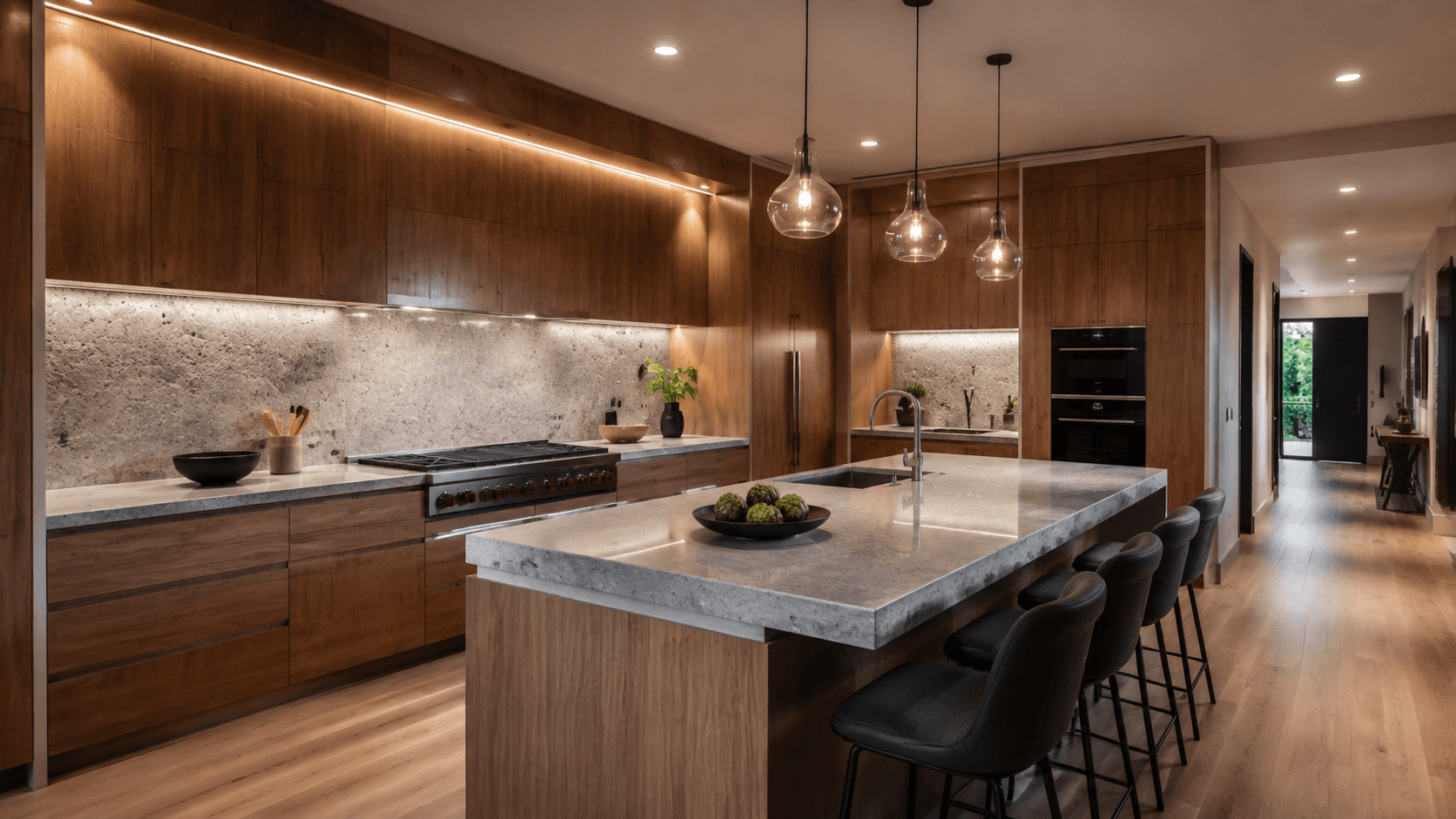
- 12–200 mmtrue focal lengths, on a full 36 mm frame
- f/1.4–f/32depth of field, per saved shot
- 1800–8000 Kcolour temperature, per fixture
- Unlimitedsaved cameras — each re-renders after changes
Cameras
- Real lenses. True focal lengths from 12 to 200 mm on a full 36 mm frame — named rungs at 18, 24, 35, 50 and 85 mm, a continuous slider underneath.
- Height that means something. Five named heights from Low (0.6 m) to Standing (1.65 m), adjustable from 0.1 to 3 m; the camera and its aim rise together so the shot stays level.
- Straight verticals. A one-toggle two-point perspective, so cabinet stiles stay parallel the way an architectural photograph keeps them.
- Depth of field. Per shot, f/1.4 to f/32, focused where the camera looks.
- Saved shots, unlimited. Every camera is saved with its exact position, lens and settings, renameable and re-frameable — and a saved shot re-renders after any design change. Change the island, press render, get the same five compositions of the new room.
- Today’s frame. Output is 16:9 — 1280 × 720 at Draft, 1920 × 1080 at Studio and 3840 × 2160 at 4K Ultra, with a 16-bit master and scene-linear EXR beside the Studio and 4K Ultra images.
Lighting
- Four fixtures, chosen by purpose. Recessed downlight, soft ceiling panel, under-cabinet strip, narrow-beam accent — placed by clicking where the light should land; the fitting hangs itself.
- Physical brightness. Per-fixture, 5–200 W, passed to the renderer unchanged — the preview and the render agree because they are computing the same watts.
- Colour temperature. Room-wide rungs from candle (2200 K) to daylight (6500 K), with per-fixture override from 1800 to 8000 K, computed by physical blackbody.
- Under-cabinet runs. Wall cabinets are grouped into runs automatically — one continuous channel per row, one click per row, or light them all at once.
- A light meter. The room’s illumination read in watts per square metre, so “is this enough light?” has a number. It reports; it never acts.
- Stated plainly: interiors are lit by the fixtures you place. Sun, time-of-day and HDRI environments are not offered today.
Computed by physical blackbody on both sides of the pipeline, so the preview's warmth is the render's warmth.
Materials and finishes
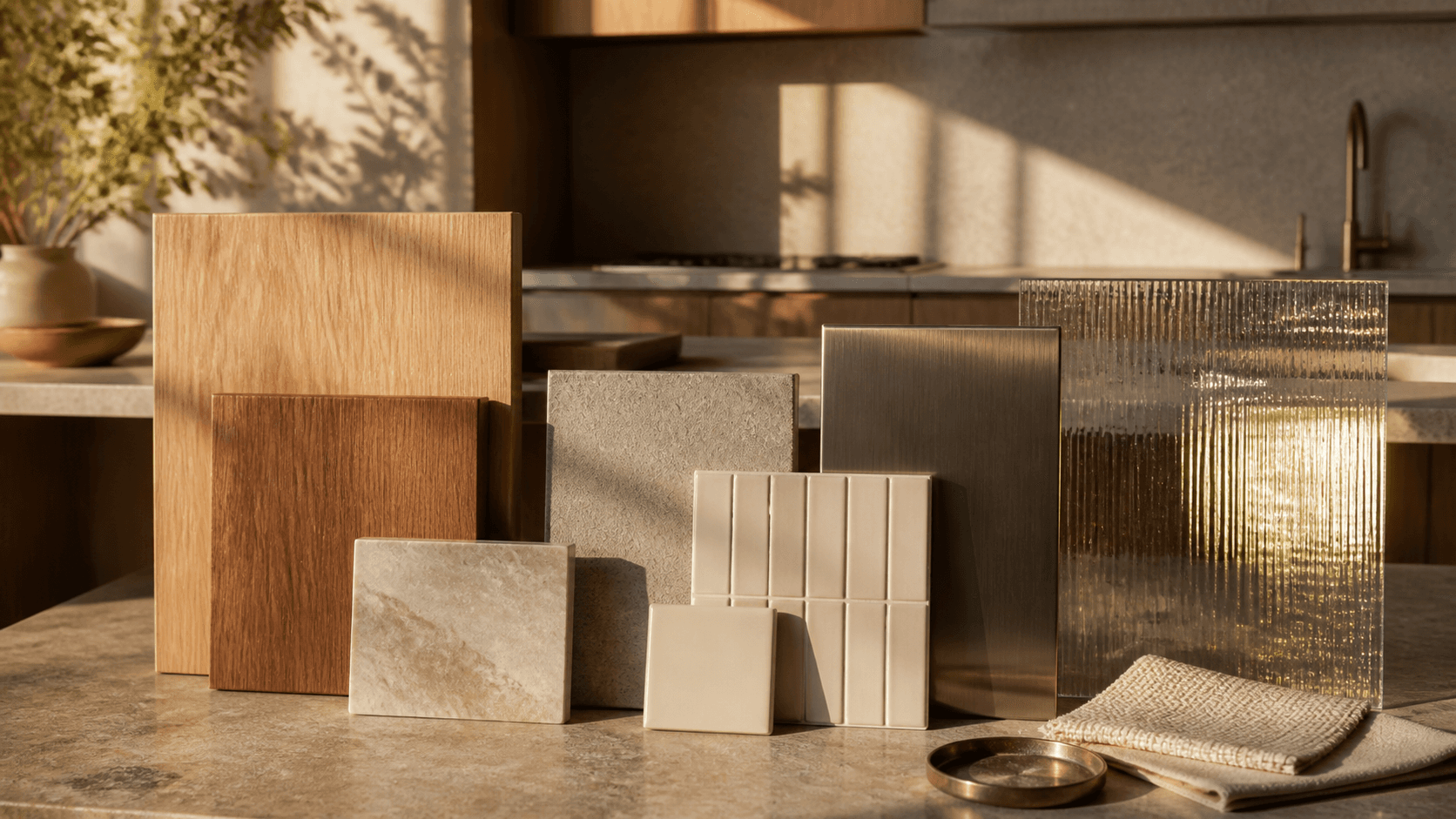
- Ten substances, measured variants. Paint, metal, glass, stone, concrete, ceramic, wood, laminate, vinyl plank, fabric — each variant a complete, physically measured surface.
- 556 real textures. A curated CC0 library with genuine normal and roughness maps, searchable, with real-world tile sizes where the source publishes them.
- Your export respected. Wood, stone, tile and laminate keep the exported photograph and add light response; paint, glass and metal replace it — the fidelity page explains why. Texture scale and a grain-turn dial fix mappings 2020 laid sideways.
- Nothing destructive. The original surface is one click back, always — it never left the file.
- Stated plainly: designer-uploaded models and materials are not offered today (the library is curated for scale, materials and licence), and there is no cross-project style preset yet — cameras and lighting are per project.
What it adds up to
A professionally photographed interior is a lens choice, a lit room, and materials that respond to light. Those are the three systems above, applied to the model exactly as 2020 wrote it and rendered on cloud hardware — then handed over as a live 3D link the client can turn over from any angle.
Bring your next 2020 project.
Free for 14 days on your own kitchen: render it at every quality and hand a client a live link before you have paid anything. Cancel in one click.
Start free